
Safer, stronger organisations start here
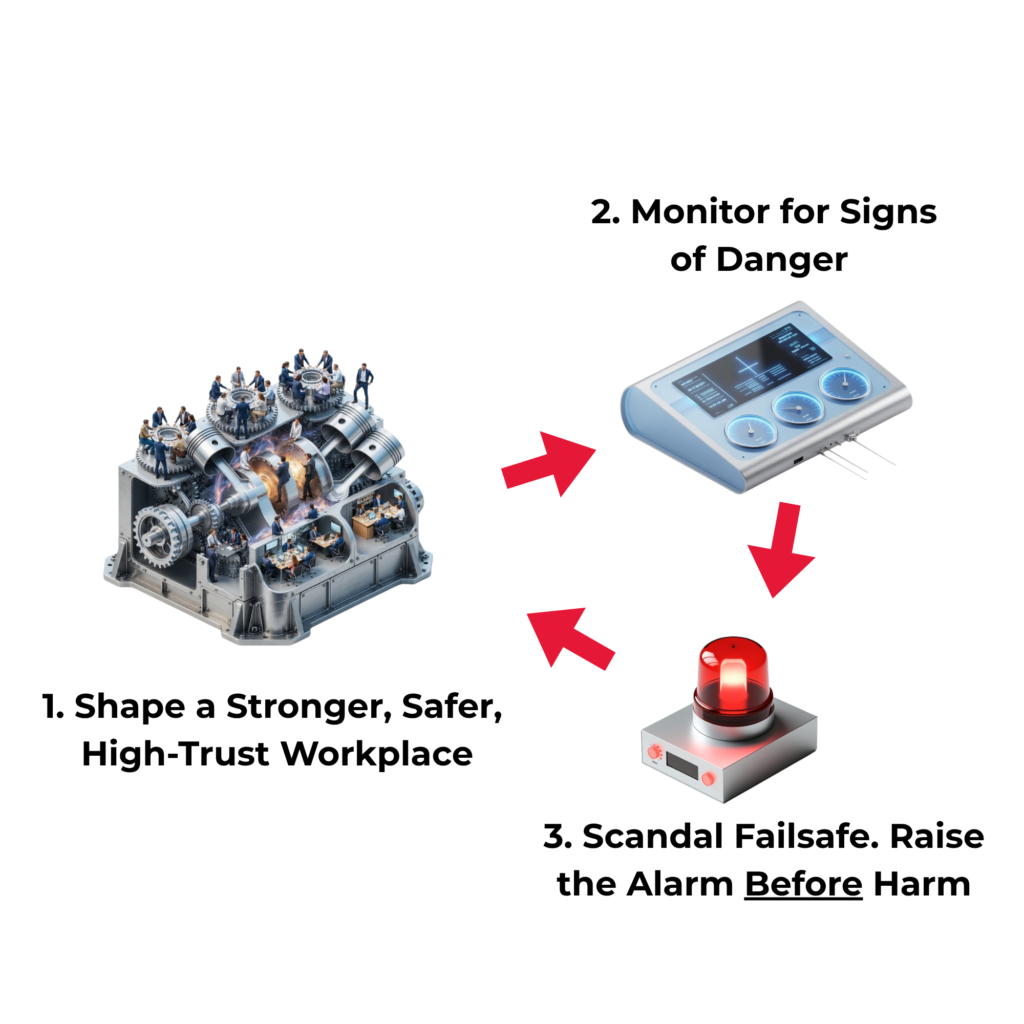
This page is about the first of three steps: building trust so problems struggle to take root. Steps two and three matter. They are important. They watch for danger and raise the alarm before harm becomes a scandal.
Those steps stop damage. Step one is different. It strengthens the organisation itself — the place where people work, and where its services are delivered.
Public organisations sit under six forces. They tend to be mature (often with long serving staff), hierarchical, rule-driven, complicated, complex, and large. Left alone, those forces wear trust down. A low-trust organisation is not only a poorer place to work. It is a more dangerous one.
The work on this page is practical. Each video shows one way trust can be built, repaired, or sustained. Read the short description with each video: what it covers, and why it matters. As you watch, notice how many of the methods are free or low-cost.
This is only a small selection — enough to see how trust can be shaped. The full set of tools is much larger. If you work with us, that armoury becomes available.
At the bottom of the page is Aaron’s story. Watch it if you want to see how Change Levers became a book, a website, and our work.
The Circle of Trust Repairs, Builds and Sustains Trust
Public sector scandals rarely come out of nowhere. They grow where trust is already weak. Afterwards the same problems appear: people did not see, stayed silent, kept out of the way, were busy elsewhere, or were unsure who was responsible, and more.
This short explainer identifies the six forces that impact how public organisations work. Left unchecked, those forces can damage the workplace, weaken trust, and create the conditions for serious harm. The countermeasure is the Circle of Trust: Relationships, Truth, and Safety, each moved by practical Change Levers such as transparency, honesty, and ethics.
Monitoring can stop a scandal in motion. The Circle of Trust does something different: it creates a better workplace, where problems are far less likely to escalate. Watch to see how to repair, build, and sustain trust. Contact us to learn more, or to see whether we should work together.
VIDEO 1
VIDEO 2
L.A.D.D.E.R. & Workplace Guardians: Making It Safe to Raise Concerns
This short explainer shows what happens after they do — when a concern goes to a manager, sits in a reporting system, or becomes whistleblowing. It maps a path many dedicated people never expected: delay, organisational pinball, silence, exit, or a scandal that did not need to happen.
It then puts four questions to leaders and managers. Would staff still speak up if they could see this journey? What would leadership expect? Are managers handling difficult situations, or should they hang their heads in shame? And what would service users — and the public who pay for it — make of all this?
Then it shows the fix: L.A.D.D.E.R., with leadership-driven Workplace Guardians. A process that sits where most systems fail, so raising a concern is safe, fair, and resolved — and problems are caught before they become scandals.
Watch it. Then get in touch if we should work together.
VIDEO 3
Party Politics in Public Sector Workplaces
Would you let one political party canvass at the door of a public building?
This short explainer is for those who lead and manage in the public sector. It puts a practical question on the table: who is allowed to campaign around your workplaces — and how do you know your teams would handle every party the same way? Assumption and common sense are not a policy. They look like favouritism the moment someone disagrees.
The film shows why a clear, visible rule on political activity — applied equally, understood by estates, security, and managers — is a low-cost protection. It prevents embarrassment. It also protects Relationships in the Circle of Trust, where fairness and transparency either hold or quietly fail.
Watch it to see how to take party politics out of the grey area before it damages trust.
Contact us to learn more, or to see whether we should work together.
VIDEO 4
Staff as Partners: The Only Way Values Become an Ethical Guide
When the manual runs out, staff still need to know the right thing to do. Rules cannot cover every moment. Core values can — but only if they are real.
This short explainer is for political and public sector leaders who have seen the slogans on the wall and felt how little they protect anyone when things get hard. It shows why ethics sits inside the Circle of Trust, and why a list of nice words is marketing, not a guide.
The film sets out the harder route: operationalising values with staff and teams, so they shape decisions, conversations, and everyday action. Done that way, values become an ethical path — supporting truth, strengthening trust, and making organisations safer, stronger, and better at delivering services.
Watch it to see how core values can move from the poster to the work.
Contact us to learn more, or to see whether we should work together.
VIDEO 5
Long-Serving Staff Are an Asset - Here’s What Gets Missed
Long service is one of the public sector’s quiet strengths. It can also be one of its least examined risks.
This short explainer is for those in public sector leadership roles, management and HR. It looks past the familiar pros and cons of long-serving staff and stable teams to consider what is easier to miss: the personal relationships and the history staff carry with one another.
Old alliances, old grievances, and lost moral authority can start to filter the work. Delays follow. Service users pay the price.
You cannot, and should not, stop long service. The film shows a better course: keep the advantages, weaken the drawbacks, and take personal history out of the way of the job. Using the Circle of Trust, leaders can push change levers such as fairness, ethics, psychological safety, and transparency through the organisation — so people can focus on the work, not the past.
Watch it to see how mature teams stay strong without letting the past run the workplace.
Contact us to learn more, or to see whether we should work together.
VIDEO 6
Strengthen Honesty Before Blurred Conduct Becomes Culture
Most people think honesty is obvious. That is a mistake, as we explain in this short explainer video, aimed at those who set standards and manage others.
It shows why the easy cases — theft, clear fraud — are not the only risk. The risk also sits in the middle, where small acts can be justified. When those judgements blur, losses of time, money, and reputation pile up and become culture.
The video does not leave it there. It shows how honesty can be strengthened before blurred conduct settles in — supporting Truth in the Circle of Trust, and helping public organisations stay safer and stronger under the pressures they already face.
Watch it to see the honesty problem clearly, and what leaders can do about it.
Contact us to learn more, or to see whether we should work together.
VIDEO 7
The Workplace Trust Account: How Trust Is Built - and Destroyed
Everyone at work has a trust account. Every action is a deposit or a withdrawal.
This short explainer is for those who lead and manage in the public sector. In under two minutes, it shows how fairness, clear explanations, and keeping your word build the balance — and how broken promises, ignored problems, and unfair decisions take it away. People notice. Effort drops. Silence grows. In the worst cases, the workplace becomes unpleasant, even dangerous.
Trust can leak away slowly, or vanish in a moment. Rebuilding only happens one deposit at a time.
Watch it to see the Trust Account clearly — a simple way to judge the impact of everyday choices, and to start putting more in than you take out.
Contact us to learn more, or to see whether we should work together.
VIDEO 8
Employing Family: Why It Can Build or Break Trust
There is something leadership can overlook, and the workforce almost never does.
This short explainer is for those in public sector leadership roles, management and HR. It looks at employing family: why it can strengthen an organisation — and why, if fairness is not visible, it can breed resentment and quietly damage trust.
When a hire, shift, or promotion looks uneven, stories travel faster than any memo. That disruption is unnecessary. It is also avoidable.
The film sets out a practical path. Hold every appointment to three standards: transparency, fairness, impartiality. Let staff help shape how family members are hired, managed, and promoted, so people can see that the rules apply equally.
Checking this costs little. A workplace that no longer believes the system is fair costs far more.
Watch it to see how getting this right supports Relationships in the Circle of Trust — and helps build safer, stronger organisations.
Contact us to learn more, or to see whether we should work together.
VIDEO 9
How One Manager’s Favour Hurt Trust
It began as a small favour. A permit signed. Old furniture taken away. Then someone got hurt — and the decision looked very different.
This short explainer is for those who set standards and manage others in the public sector. It follows one everyday choice through the Circle of Trust: Safety, Relationships, and Truth. No risk assessment that held. A favour not offered to everyone. Public assets moved as a personal kindness. Staff notice. Trust drops. Moral authority is hard to get back.
The film is not about one manager’s mistake. It shows how small, well-meant exceptions teach people that rules are optional — and how that makes the next breach easier to ignore.
Watch it to see how the Circle of Trust helps leaders judge favours before they become culture, injury, or a loss of standing they cannot repair.
Contact us to learn more, or to see whether we should work together.
VIDEO 10
Public Sector Reality After the Vision | Aaron’s Story
Aaron joined the public sector believing in the vision — and in something larger than himself. This short animated film tells the story of what he found there.
Watch it, and you’ll see what drives us: the conviction that public service can be done better.
If this resonates, get in touch. We’d like to learn whether we should be working together.
What happens next is up to you
If you lead, manage or work in a public-sector organisation and want to build a safer, stronger workplace, get in touch.
Just click the button to arrange a chat.